
Court records for Wichita County, Texas, are maintained by the District Clerk and County Clerk and are accessible through online tools, official court portals, and directly at the clerk's office. WichitaCourt.us allows quick access to public information about court cases in the county. Additional resources include the official website of the city of Wichita Falls, Texas state portals, and the district clerk's office, where certified copies of documents can be obtained or public records requests can be submitted.
Wichita Court System Overview
Wichita County is part of the 30th and 89th Judicial Districts of Texas. District Courts handle serious criminal cases and high-value civil lawsuits, while County Courts and County Courts at Law deal with less serious criminal and civil matters. Appeals from Wichita County courts go to the Second Court of Appeals of Texas in Fort Worth, which serves twelve counties in north-central Texas.
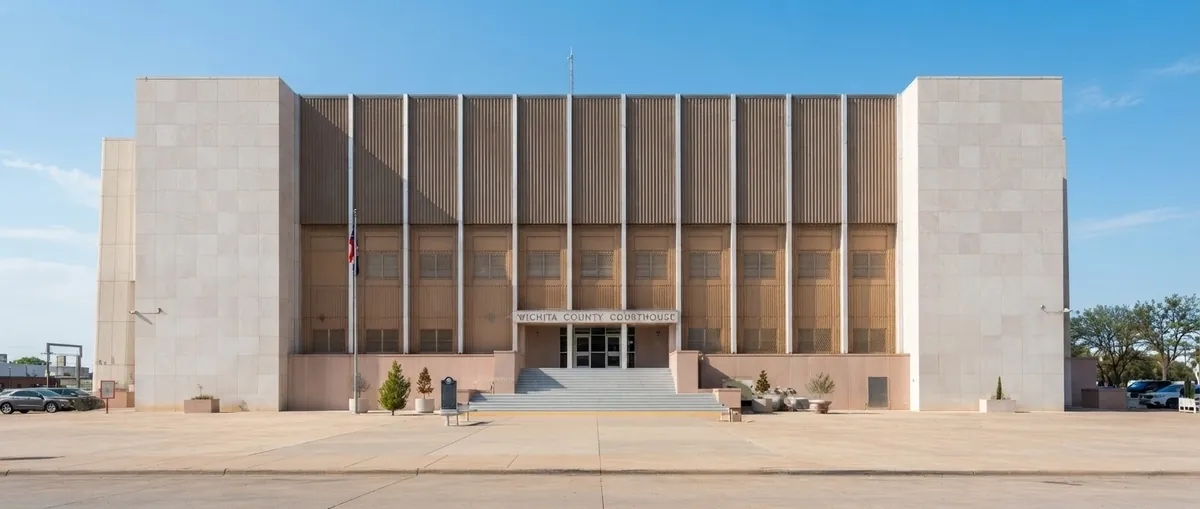
The main judicial complex is located in the Wichita County Courthouse in Wichita Falls. Courts operate on weekdays, typically from 8:00 AM to 5:00 PM. Specific hours and contact information are provided below in the court listings section.
Courts Serving Wichita
Residents of Wichita County are served by several courts with different levels of jurisdiction:
State District Courts
County Courts at Law
Wichita Falls Municipal Court
The Municipal Court handles violations of city ordinances and Class C traffic offenses.
Federal Bankruptcy Court
Wichita County is part of the Northern District of Texas. The Wichita Falls Bankruptcy Court Division handles bankruptcy cases for this region.
What Types of Cases Wichita Courts Hear
Wichita County courts handle a wide range of cases. Here are the main categories:
- Felonies and misdemeanors
- Traffic violations and minor Class C offenses
- Civil lawsuits — from small claims to complex commercial disputes
- Family law: divorce, child custody, alimony, paternity
- Probate, guardianship, and conservatorship cases
- Juvenile matters and child protective services cases
- Adoption and termination of parental rights
Each category has its own filing and processing procedures, depending on the court level.
District Court Cases in Wichita
The 30th and 89th District Courts handle the most serious cases. This includes all felony criminal cases after a grand jury issues an indictment. Civil lawsuits exceeding the jurisdictional limit of the county courts are also heard here — including real estate disputes, major contract conflicts, and damage claims.
A district judge presides over each session. Cases are distributed between the two district courts according to internal rules. Additionally, district courts hear appeals from lower courts and post-conviction motions, including habeas corpus.
Magistrate Court Cases in Wichita
In Texas, the functions of a magistrate court are performed by County Courts at Law. In Wichita, two such courts handle Class A and B misdemeanors, preliminary hearings in felony cases, and civil claims with a dispute amount up to $200,000 according to state law.
Small claims are filed through Justice Courts and are limited to $20,000. Class C traffic violations, including Class C misdemeanor DUI, are handled by the municipal court or Justice Court. County courts also conduct arrests and initial hearings for individuals detained for felonies before the case is transferred to district court.
Family Law, Probate, and Juvenile Matters in Wichita
Family Law
Divorces, custody disputes, paternity establishment, and protective orders are handled by the 30th and 89th District Courts. If a case involves exclusively family law, it typically goes to one of these courts according to internal distribution.
Probate and Guardianship
Probate cases, the appointment of guardians and conservators, and trust disputes are handled by the County Court or County Court at Law. The county clerk maintains the registry of wills and probate cases.
Juvenile Matters
Juvenile cases are confidential under Texas law. Juvenile delinquency and child protective services (CPS) cases are heard in district court. For information on juvenile cases, contact the Wichita County Juvenile Probation Department.
How Cases Move Through the Wichita Court System
- Case Initiation. A criminal case begins with the filing of a complaint or indictment; a civil case begins with the filing of a petition with the clerk's office.
- Judge Assignment. The case is assigned to judges according to internal court rules and the case category.
- Initial Hearings. In criminal cases — arraignment, where the defendant is informed of the charges. In civil cases — scheduling conference.
- Pre-trial Phase. Parties exchange evidence (discovery), file motions. In criminal cases, plea negotiations are possible.
- Trial or Settlement. The case concludes with a jury verdict, judge's decision, settlement agreement, or plea deal.
- Post-Decision. Sentencing, appeal to the Second Court of Appeals, or enforcement of judgment.
Court Administration, Local Rules, and Public Access in Wichita
The administrative judge of the county coordinates the work of Wichita County courts. Local court rules are established separately for each judicial district and are available on the Texas Office of Court Administration website.
Under the Texas Public Information Act, most court records are public. This means anyone can submit a public information request to the appropriate authority. Some records — including juvenile cases, sealed cases, and certain family cases — have restricted access.
Hearings are generally open to the public. Visitors may appear in person at the courthouse. For information on remote participation in a specific case, contact the relevant court's office.
Court Records and Related Court Resources in Wichita
- Case Search. District and county court records are available through the search system at WichitaCourt.us or through the official county clerk's portal.
- Criminal Records. The Wichita Falls Police Records Division maintains crime and accident reports. For state-level criminal history checks, contact the DPS Texas Crime Records Division.
- Vital Records. Birth, death, and marriage certificates can be obtained through the Wichita Falls Vital Records Division or ordered online through the DSHS Texas portal.
- Marriage and Divorce Indexes. Marriage license and divorce decree indexes are available on the DSHS website. Local divorce records are maintained by the Wichita County District Clerk.
- Municipal Court. Information on traffic fines and city ordinance violations is provided by the Wichita Falls Municipal Court.
- County Tax Office. The Wichita County Tax Office handles vehicle registration and related records.
- Federal Bankruptcy Court. Bankruptcy cases in Wichita Falls are accessible through the PACER system on the Northern District of Texas website.
- Police Department. The Wichita Falls Police Department provides information on current operations and community safety.